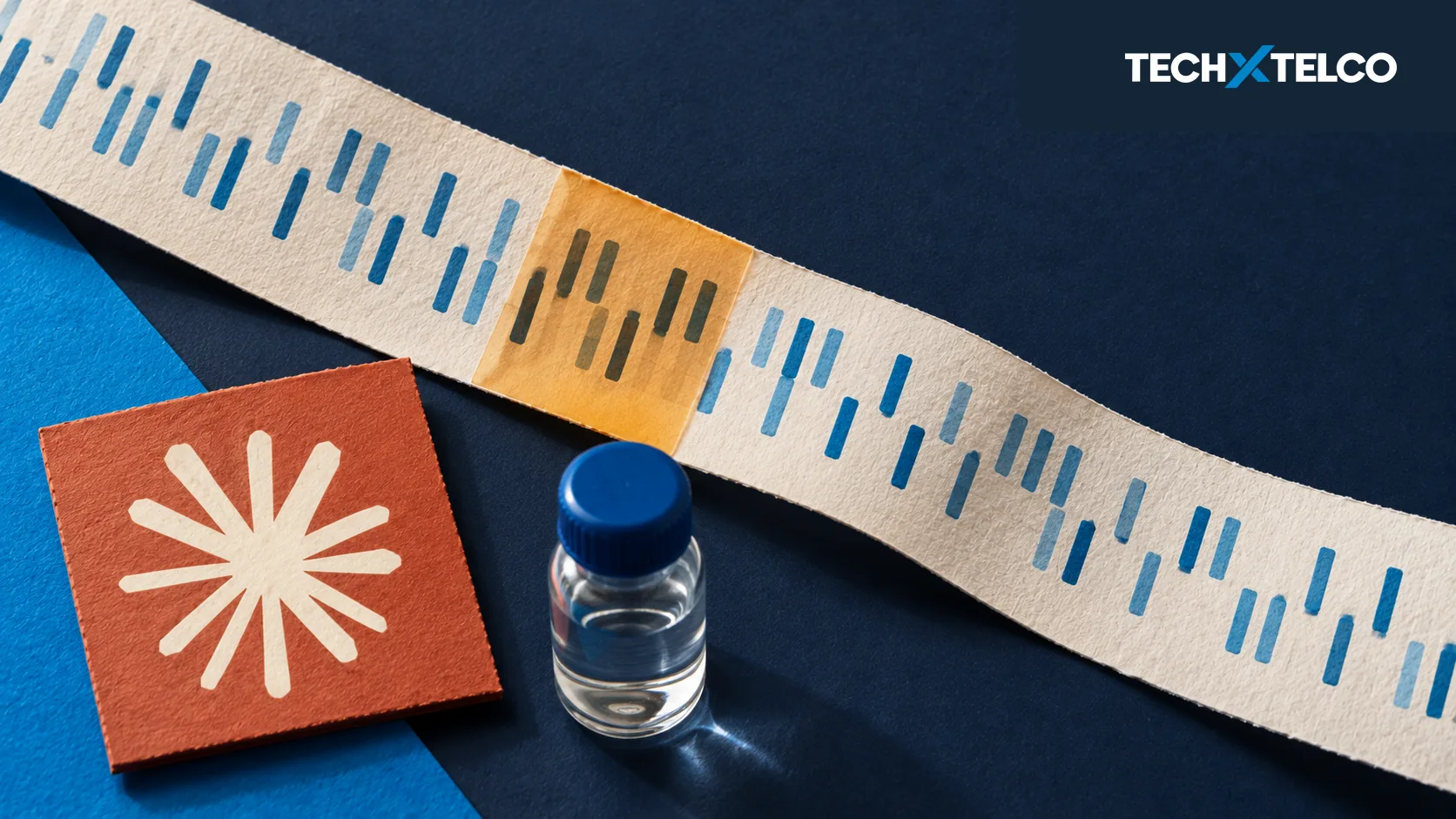

Anthropic says Claude helped identify an unusual biological system by spotting repeated DNA beside an enzyme. The company announced the work on 23 September alongside its new life sciences research group and laboratory.
What you need to know
Claude appears to have noticed defining features that earlier work missed around a previously known enzyme. That is a meaningful research claim. It is not a demonstrated new medicine or a ready-to-use gene-editing tool: the system’s function remains unknown, and human scientists performed the laboratory work.
What was new about the discovery?
The enzyme is a reverse transcriptase, a class associated with copying RNA into DNA. Anthropic says this particular enzyme had already been identified. The new observation was the surrounding system: repeated non-coding DNA and an additional partner protein. The researchers call the family array-associated reverse transcriptases, or ART.
The finding was a connection between pieces of biological data: the enzyme, neighbouring repeats and a partner protein. Recognising that arrangement gave scientists a specific system to investigate.
What did Claude do, and what did people do?
Where the work happened
The announcement separates computational discovery from experiments.
Claude agents
investigate the data
- Search sequences, examine unusual features and produce candidate reports.
Human scientists
perform the lab work
- Carry out experiments and investigate what the system does.
The paper reports 949 agent sessions, 21.5 elapsed hours and 215.6 million tokens for the computational campaign, without human intervention after the brief. Sessions are not separate models or a count of scientists replaced.
There is real autonomy in that description. It would be misleading to reduce the work to a chatbot rewriting a scientist’s notes. It would be equally misleading to stretch autonomy in one stage into a claim that AI ran the entire scientific process by itself.
What the agents actually did, step by step
Start with a research brief. Human researchers set the goal. Software paired worker agents with supervisor agents that reviewed their plans and results.
Search and sort. Using Mythos 5, the campaign surveyed about 1.9 billion protein clusters and recovered roughly 200,000 reverse-transcriptase clusters for classification.
Follow an unexpected pattern. An agent noticed repeating DNA beside an unusual enzyme. It counted the repeats, checked their spacing, compared known systems and searched the literature before reporting the finding.
Take the candidate into the lab. Anthropic says its scientists review Claude’s hypotheses and perform the experiments on the promising ones. The second post above explains this division of work.
The useful distinction is between finding more examples of something familiar and spotting a relationship worth a new investigation. Here, the repeat pattern gave the researchers a concrete question to test. That is the substance behind the discovery claim.
The strongest caveat is in the paper
The preprint’s Discussion says the researchers have not shown that the reverse transcriptase is active or that the observed RNA units are its substrates—the material it acts on. Whether the enzyme interacts with its partner, and what the system does for the virus carrying it, remain unknown.
The abstract reports evidence that the arrays are expressed as separate units during infection by a bacteriophage, a virus that infects bacteria. That supports further investigation; it does not answer all of those functional questions.
Why the CRISPR comparison needs care
Anthropic highlights similarities between the repeated sequence layout and CRISPR. The comparison is a reason to investigate possible uses, not proof that ART can perform the same job. The work has been released as a preprint, and this article reports the authors’ findings rather than an independent replication.
When you read a discovery headline, it helps to separate three questions: was something unusual found, do researchers know how it works, and has anyone demonstrated a useful application? A strong answer to the first does not automatically answer the other two.
For this story, the next evidence worth watching is functional: what the system actually does, whether the proposed components work together, and whether other researchers can reproduce the findings. A product demo or another comparison with CRISPR would not settle those questions.
The interesting AI result is the ability to pursue an odd observation in a large body of data. Its practical value will become clearer as scientists establish which of those observations survive experimental testing. That is a more useful way to judge progress than treating every candidate discovery as a finished breakthrough.
Related: what Anthropic’s 26% AI research claim measures
Sources and further reading
Anthropic: Claude discovers a novel enzyme systemPreviously known RT, newly recognised associated features, human laboratory work and unknown function.www.anthropic.com
Research preprint: Autonomous AI agents discover reverse transcriptases with tandem repeat arraysAbstract; Results, Agentic genome mining with Claude; Discussion, printed pages 13–14.www-cdn.anthropic.com
Anthropic on X: discovery announcementOriginal announcement and its qualification about unknown function.x.com
Michel Elijah covers technology, streaming and online security for Tech X Telco. He writes practical how-to guides on everything from email troubleshooting to spotting the latest scams doing the rounds in Australia, with a focus on clear steps anyone can follow.
Spotted something wrong? Corrections are recorded in the open. Report a correction