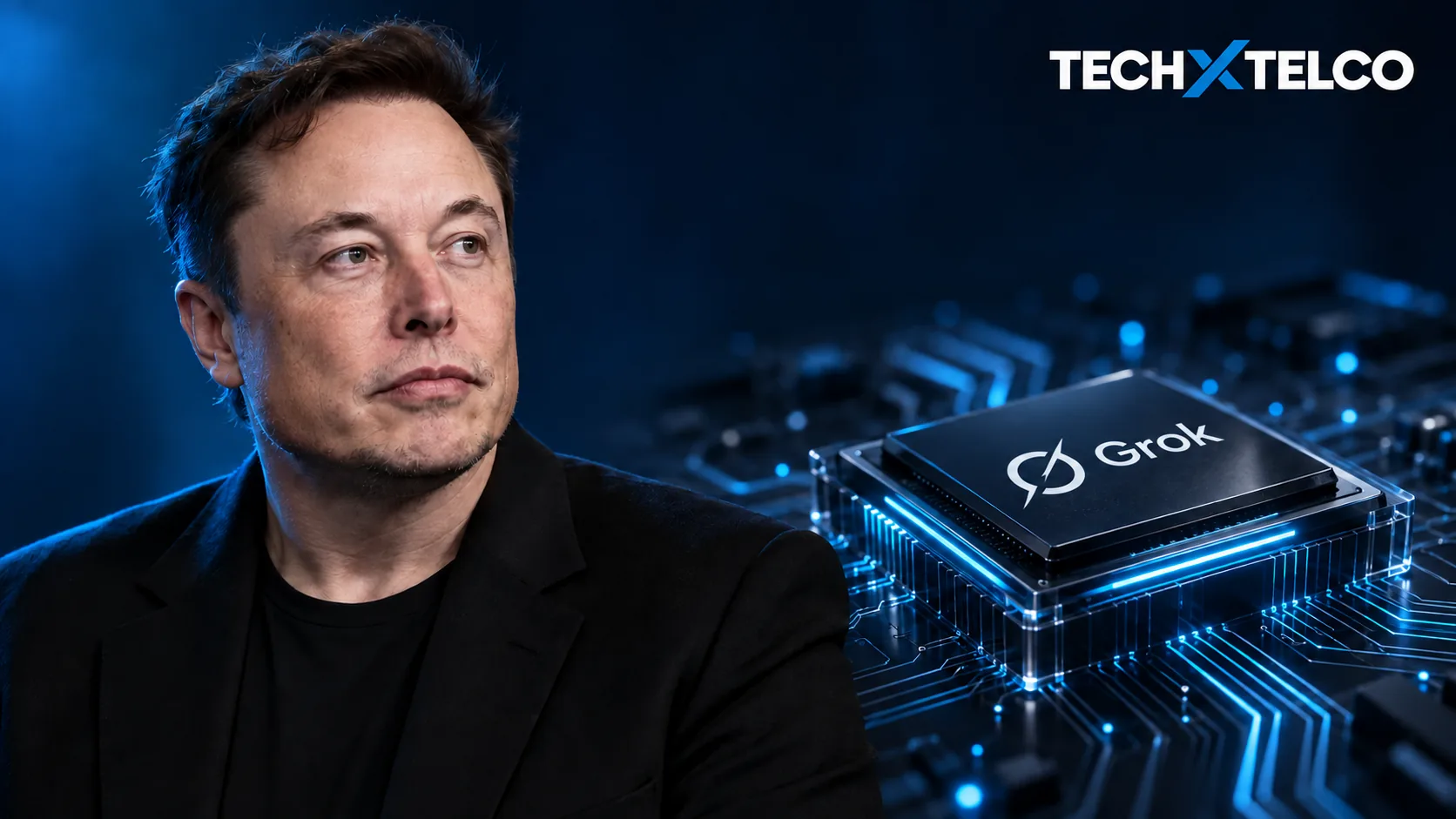

Elon Musk says Grok 4.8 is a 2.5-trillion-parameter model approaching the end of a training stage, with reinforcement learning to follow. It is a substantial claim about the next Grok. His post does not establish that a finished model will arrive this week.
The distinction matters if you are deciding whether to pay for Grok, move a work project to it or believe predictions that it will overtake rival assistants. A model’s size, its training schedule and its usefulness are three different things.
What has actually been announced?
Musk has described a 2.5-trillion-parameter Grok 4.8 trained using a new C++ stack, with reinforcement learning next. He has not given a public release date in that post. The size, timing and performance expectations remain company claims, rather than independently verified results.
Finishing training is not the same as being ready to use
The final two words of Musk’s update are the important ones: reinforcement learning remains ahead. His wording describes a transition within development. It does not say that paying customers will receive Grok 4.8 when the current stage ends.
In broad terms, reinforcement learning adjusts a model using rewards for its behaviour or results. For a coding task, a reward might depend on whether a solution passes tests; for a mathematical problem, whether the answer is correct. That is an explanation of the method, not a disclosure of Grok 4.8’s training recipe.
DeepSeek’s R1 research offers a concrete example of why this stage matters. The researchers reported substantial reasoning improvements from reinforcement learning, including on verifiable tasks such as mathematics and coding. It shows why more development after the main training run can change what a model does. It cannot tell us how long Grok’s work will take or how successful it will be.
When checked on 15 September 2026, the official SpaceXAI news index did not list a Grok 4.8 launch, and the developer introduction still identified Grok 4.6 as its latest model. We did not verify a Grok 4.8 release date, price or API identifier in those sources. That is a dated availability check, rather than a promise that the pages will stay unchanged.
What does 2.5 trillion parameters actually tell you?
Parameters are the numerical values a model learns during training. They help determine how it processes an input and produces an output. A parameter count is not a count of verified facts, and it does not tell you how many documents the assistant can read in one conversation.
There is another distinction hidden inside the headline number: the total parameters a model contains versus how many it activates for a particular token. A mixture-of-experts model routes work through selected parts of the network. Its full size can therefore be much larger than the amount used for each token.
For a historical example, DeepSeek’s December 2024 V3 announcement listed 671 billion parameters but 37 billion activated parameters. That example explains the distinction; it is not evidence that Grok 4.8 uses the same architecture. Musk’s short update does not disclose an active-parameter count.
Training data matters too. The 2022 Chinchilla research examined how to divide a computing budget between model size and training data. Its findings challenged the idea that making the model larger was always the best use of the available resources.
So the sensible response to 2.5 trillion is curiosity about the architecture, training and results. You cannot turn it into a percentage improvement over an assistant with a smaller published number. You also cannot infer its accuracy on an Australian phone bill, its image-reading ability or its subscription price.
Musk’s roadmap comes with caveats worth keeping
In a separate post, Musk places Grok 4.7 around Opus 5.0 rather than 5.1, while acknowledging strengths, weaknesses and multimodal problems. He predicts an improvement with 4.8, suggests 4.9 could be comparable to Astra and Fable, and leaves open the possibility of Grok 5 leading the field.
Those are Musk’s assessments and forecasts. The post does not supply the test conditions, results or independent evaluations needed to establish a ranking. Describing 4.9 as already matching a rival would turn a prediction into a result.
The multimodal caveat is particularly relevant to ordinary use. An assistant that writes a convincing explanation may still struggle with information in an image. If your task is reading a screenshot, diagram or scanned page, performance on text-only questions is an incomplete guide.
A useful comparison needs the exact model version, settings, tools and task. Giving one assistant web access and several attempts while restricting another to a single response would answer a different question from comparing them under matching conditions.
The C++ detail is interesting. It is not a speed benchmark
Musk also says the C/C++ training stack was written by people. He argues that current AI remains inadequate for extremely demanding performance engineering, while expecting that to change. That is a narrower claim than saying AI cannot write useful code.
C++ itself is not unusual in machine learning. PyTorch provides a C++ frontend and explains that its Python interface sits on a substantial C++ codebase, including tensors and automatic differentiation. The choice is more nuanced than replacing a slow language with a fast one.
The interesting engineering question is whether this particular stack does the work more efficiently and reliably. A convincing comparison would identify the hardware, workload and baseline, then measure the improvement. The three Musk posts reviewed here do not provide that evidence.
Nor does “written by humans” establish whether developers used an AI assistant for any supporting task. We have not inspected the code or development process. The defensible point is that Musk credits people with the stack and draws a boundary around what he thinks current AI can do.
Our reading is that this is a useful counterweight to sweeping claims about software jobs disappearing overnight. Producing working code and taking responsibility for an exceptionally demanding production system are different achievements. This example does not quantify AI’s effect on employment, but it does caution against treating every programming task as interchangeable.
How does this fit with calls to pace AI development?
The timing invites an obvious question: why discuss restraint while preparing larger models? The answer depends on what restraint means.
In We Must Pace the Frontier, Dario Amodei explicitly distinguishes pacing from halting model training. His proposal calls for time to improve safeguards and for third-party evaluation, including evaluators with access inside frontier labs. Continuing a training run is therefore not, by itself, proof of violating that proposal.
Our report on the Amodei, Musk and Altman debate explains the wider context.
There is still a serious accountability question. What would make a developer delay release? Who gets to examine the evidence? Can reviewers report findings that the company would rather keep quiet? A training milestone answers none of those questions.
It would be equally mistaken to declare a model safe or dangerous from its parameter count alone. The relevant evidence concerns its capabilities, behaviour, access to tools and safeguards. The public deserves specifics about those things alongside the claims about scale.
What should you do with this news?
If you already use Grok, treat this as a development update. If you are considering paying for it, judge what your account can access today. A forecast about a future model is a poor substitute for a feature you need this afternoon.
When a new version becomes available, one useful way to assess it is to repeat a task your current assistant handled badly. For example, give it a fictional Australian mobile bill containing a recurring charge, a one-off credit and an introductory discount. Ask it to distinguish this month’s total from the ongoing cost and show the lines supporting its answer. Keep the same input and instructions for each model.
That is a suggested comparison, not a test we have conducted. Use invented or redacted material, and check the arithmetic yourself. Notice how much correction the answer needs, not just how polished it sounds.
The case for Grok 4.8 will become clearer when there is a released model, documented access and reproducible evidence. Until then, Musk has given us a development timetable and ambitious expectations. The question worth following is whether the next Grok reliably finishes more of the work people actually give it.
Primary sources
Musk’s Grok 4.8 training updatex.com
SpaceXAI official news indexx.ai
SpaceXAI Grok 4.6 developer documentationdocs.x.ai
DeepSeek-R1 research: reinforcement learningarxiv.org
DeepSeek-V3 launch specifications, December 2024www.deepseek.com
PyTorch: Using the C++ Frontenddocs.pytorch.org
Dario Amodei: We Must Pace the Frontierdarioamodei.com
Michel Elijah covers technology, streaming and online security for Tech X Telco. He writes practical how-to guides on everything from email troubleshooting to spotting the latest scams doing the rounds in Australia, with a focus on clear steps anyone can follow.
Spotted something wrong? Corrections are recorded in the open. Report a correction