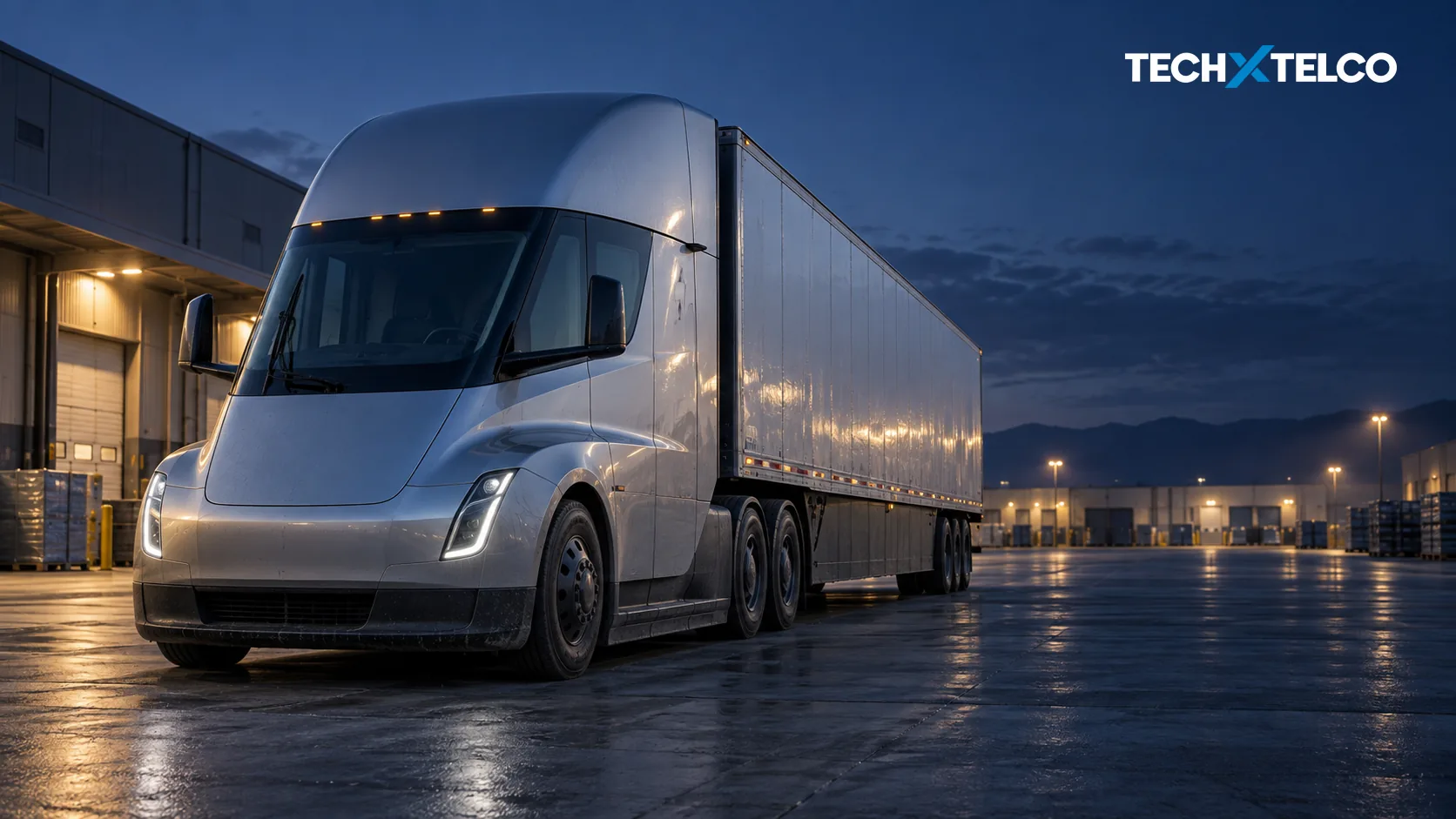

Tesla says it is starting high-volume production of the Semi, moving the electric truck story from what the vehicle can demonstrate to how consistently the company can build and supply it. That is a meaningful milestone. It is also the beginning of a production ramp, not a completed delivery target.
What you need to know
Tesla’s 25 September launch thread announces volume production and the start of deliveries. It describes annual factory capacity of 50,000 trucks. That number is not evidence that Tesla has already built or sold 50,000 Semis, and the announcement does not establish an Australian launch.
Capacity is not the same thing as trucks on the road
Tesla says its purpose-built Semi factory can produce Standard, Long Range and European-spec variants on the same line. In a separate post, it says deliveries are starting and that Tesla itself will use Semis to haul freight. It does not provide a delivered-unit total in those posts.
Three milestones to keep separate
A large factory number answers only one question.
Factory capacity
- What the production facility is designed to support over a year.
Production achieved
- How many complete trucks actually leave the line over a stated period.
Customer operation
- How the delivered trucks perform on real routes, with real loads and charging schedules.
For a fleet manager, the interesting follow-up is not another factory aerial photograph. It is a delivery schedule, service support and a vehicle that does the required route reliably. Those are the details we would look for before treating a capacity announcement as proof of a mature supply operation.
What Tesla says it redesigned
The company says it spent four years redesigning Semi for volume manufacturing. Its battery changes include moving from 2170 cells to its own 4680 cells. Tesla says this reduces battery mass and energy capacity without compromising range. These are manufacturer claims; we have not tested the truck or independently measured those improvements.
This is where a less glamorous manufacturing story can matter more than a dramatic acceleration clip. Our view is that repeatable assembly and a workable service arrangement deserve at least as much attention as a headline specification. A fleet purchases a working transport system, not just a cab.
Read the charging claim carefully
Tesla says a Megacharger can restore up to 60% of range in 30 minutes. The wording matters: it is an “up to” claim about range recovered on that charging system. It is not a promise of a full charge in half an hour, or a claim about every public charger.
For anyone assessing electric freight, the useful questions are route-specific: where would the truck charge, is that stop available when needed, and what happens if it is occupied or unavailable? We would also ask how a proposed charging stop fits the actual loading and delivery timetable. Those are assessment questions, not shortcomings we have established in Tesla’s network.
Electric does not mean self-driving
Tesla describes its electric steering as laying groundwork for future autonomy. That future-facing wording should not be rewritten as a claim that these trucks can now operate without a driver. Production, electrification and autonomous operation are separate questions.
Musk’s broader arguments about AI deserve the same separation between what he says and what a product is authorised and able to do. Our coverage of his open-source AI position examines that debate separately from this vehicle launch.
Related analysis: Musk’s open-source AI argument and the control question
What does it mean for Australia?
The launch posts reviewed here do not give an Australian on-sale date, local price or local charging rollout. A European-spec version should not be treated as an Australian announcement by another name. For now, this is an overseas manufacturing development worth following, not a reason to assume the truck can be ordered and supported locally.
Sources and further reading
Tesla Semi: volume-production announcementOpening announcement in Tesla’s original launch thread.x.com
Michel Elijah covers technology, streaming and online security for Tech X Telco. He writes practical how-to guides on everything from email troubleshooting to spotting the latest scams doing the rounds in Australia, with a focus on clear steps anyone can follow.
Spotted something wrong? Corrections are recorded in the open. Report a correction