
Since 30 June 2026, Australian mobile networks have had to publish coverage maps in a standard format and keep public registers of past outages. The rules come from the Australian Communications and Media Authority. The maps and the registers answer different questions, and neither answers the one people usually ask, which is whether the phone will work in a particular room.
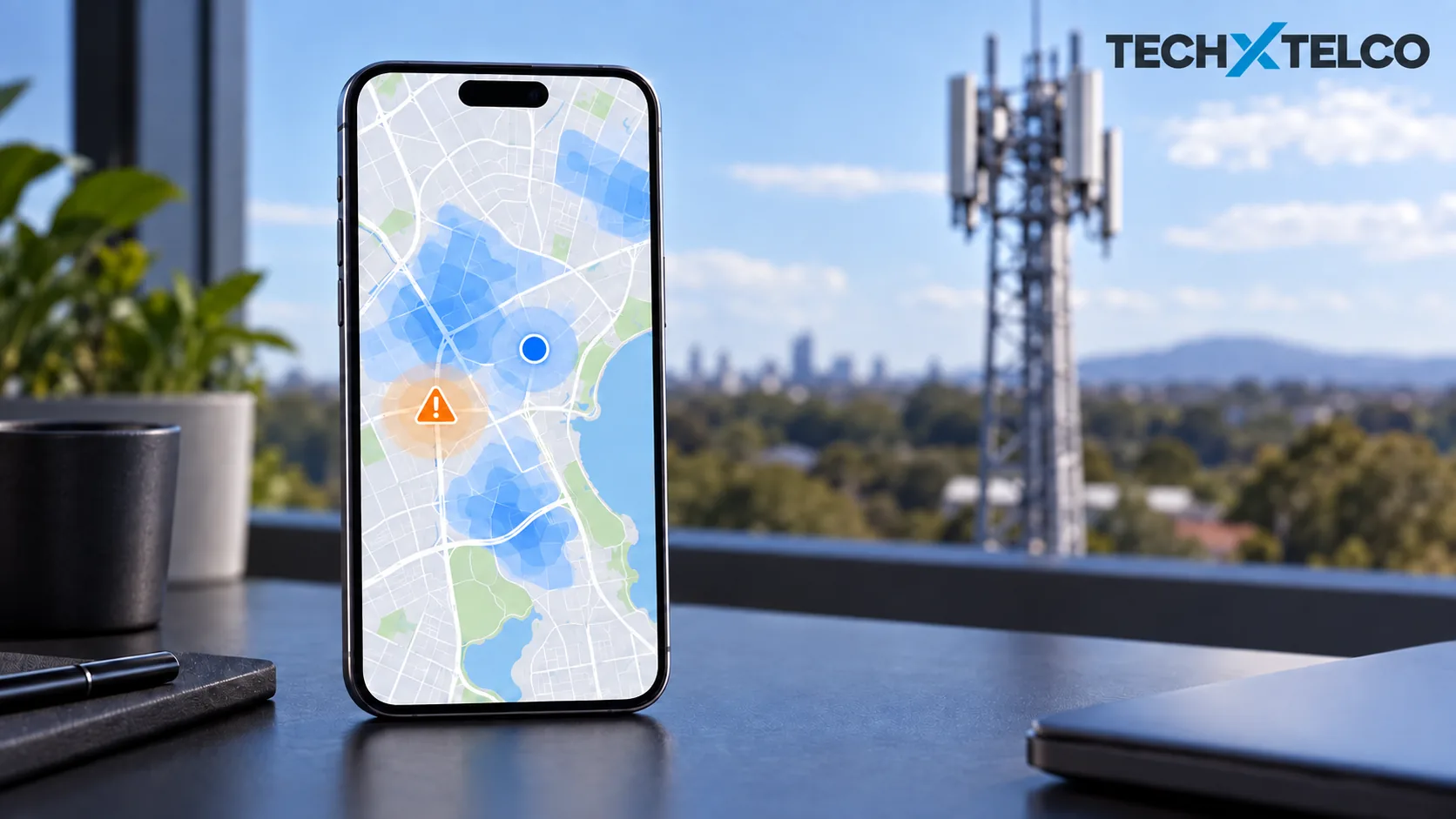
Every mobile network operator must now show 4G and 5G coverage using four categories: good, moderate, basic or no coverage, with plain-English descriptions of each, updated at least every three months. They must also publish registers of resolved major outages and significant local outages, including when each outage started and ended.
Use the coverage map to compare predicted outdoor coverage between networks. Use the provider’s live status page for a problem you have right now. Use the outage register to understand a past incident, not to rank networks.
What the Rules Require
The ACMA says the standard categories are meant to make it easier to compare coverage between networks. Each map must explain in plain English what each category means for calls and data, and be refreshed at least every three months. The outage rules require public registers of resolved major outages and significant local outages, with information including when the outage started, where it was and how long it lasted.
Source: ACMA: New telco transparency rules now in force, read 10 September 2026.
Choose the Right Tool for Your Question
Three Questions, Three Different Pages
Is coverage predicted where I need it? Use the coverage map.
- A model of outdoor coverage, in four standard categories
Is a disruption affecting me right now? Use the provider’s current service-status page.
- Live planned and unplanned outages
What happened during a past outage? Use the resolved-outage register.
- Completed incidents with start, end, duration and affected areas
A register of completed incidents is not a live diagnostic tool, and it is not a record of every individual connection problem. If your phone is not working now, the register will not tell you why.
Coverage Is a Prediction, Not a Room-by-room Guarantee
Telstra’s map says it shows predicted outdoor coverage prepared under the ACMA’s industry standard, classified into the four categories, and that it does not indicate indoor coverage. Optus’s map says it shows where you are likely to be able to connect when outdoors and at ground level, and that a compatible device, plan and SIM are needed for 5G. That scope matters when the place you care about is inside a building, a lift or a basement car park.
Source: Telstra: Our coverage, read 10 September 2026.
Source: Optus: Network coverage maps, read 10 September 2026.
Search the same location on each relevant provider’s map.
Read the category explanation rather than judging the colour alone.
Check which technology, 4G or 5G, and which assumptions the map is displaying.
Ask the provider about your intended device and service before signing up, and about its returns policy if coverage at home turns out to be worse than the map suggests.
Before switching providers, save a dated screenshot showing your address, the map legend and the selected 4G or 5G layer. If you later ask the provider about a mismatch, you can show the prediction you used. A change of map colours alone is not evidence that the physical network improved or deteriorated.
What an Outage Register Can and Cannot Show
Optus’s National Outage Register is a working example. It lists past unplanned national outages, meaning major outages and significant local outages in regional and remote areas, affecting mobile or landline services, with a reference number, start and end date and time, duration and the affected suburbs and postcodes for each. On 10 September it showed 273 entries over two years and offered a CSV export. For a current problem, the page directs you to the separate Optus Network Status page.
Source: Optus: National Outage Register, read 10 September 2026.
Use the register to check a particular incident and its recorded duration. Raw outage counts are not enough to compare network reliability: also consider the affected area, duration, severity and number of customers affected.
Sources and How This Was Checked
The rules come from the ACMA’s media release dated 30 June 2026. The Telstra and Optus pages were opened and their published wording read on 10 September 2026; interactive map searches, physical coverage, Vodafone’s pages and provider compliance were not independently tested. This is retrospective coverage explaining the rules and their limits, published on 10 September 2026.
Official Pages Used
ACMA: New telco transparency rules now in forcethe coverage-map and outage-register requirements.www.acma.gov.au
 Telstra: Our coverageTelstra’s predicted outdoor coverage map and category descriptions.www.telstra.com.au
 Optus: Network coverage mapsOptus’s coverage map and its outdoor, ground-level scope.www.optus.com.au
- Optus: National Outage Registeran example resolved-outage register.www.optus.com.au
- Optus: Network statusOptus’s live status page for current problems.www.optus.com.au
Related on Tech X Telco: Telstra pays $277,200 after mobile-fraud protection failures, another ACMA enforcement story from this month.
David Everson is Tech X Telco's mobile and broadband writer. He compares Australian mobile plans, NBN providers and prepaid deals, and tests the recharge processes, apps and tools readers ask about most. His focus is simple: helping Australians pay less for their phone and internet without losing the coverage they need.
Spotted something wrong? Corrections are recorded in the open. Report a correction